
My Minneapolis
An ode to a city that knows who it is

I must admit that when I left Minneapolis in 2013, after living there for seven years, I did not expect it to take as much of a place in the global consciousness as it has since then. I used to jokingly describe Minneapolis as “America’s best Canadian city”. Something about the place was more functional, more open, more self-effacing, more… well… nice than most other American cities.
I often compared the four places I’d lived and where Minneapolis fit. If London is cynical and self-deprecating, Boston cynical but not self-deprecating, and Northern California neither cynical nor self-deprecating (shiver…), Minneapolis was self-deprecating but emphatically not cynical. It was earnest and humble; successful but shy; quietly hipper than thou. In short not a bad place for a Brit to be as long as you could hold in your cynicism for long calls home.
When I lived in Minneapolis, the city and the state of Minnesota were very much on the rise. Economically successful with a high quality of living but still just about affordable with a vibrant, entrepreneurial restaurant and bar sector and a whole bunch of relatively philanthropic Fortune 500 companies. It was often, despite the cold, high up in glossy ‘best places to live in America’ supplements. And it had its cultural icons from Prince to Dylan, Bob Mould to the Coen Brothers.
Minnesotan-raised kids would often leave the state in their twenties but inevitably flock home within a decade, disappointed at the perceived harshness and emptiness of other American cities. They always head back.
But nobody but nobody would have claimed Minnesota was the centre of American cultural economic or political life. It was a frozen Rivendell - ethereally detached from most of the rhythms of American politics. Indeed Minnesotan politics were archaic - a Democratic Party called the Democratic-Farmer-Labour party, a Republican Party that hadn’t yet quite tipped into Tea Party mode - still the party more of Norm Coleman and Tim Pawlenty than the party it would become of Michelle Bachman and Tom Emmer. Primaries were conducted in caucuses, in school gyms or VFW bars, by old timers in plaid shirts and suspenders. Prairie Home Companion was only partly a joke about community life in Minnesota.
In the past half decade, that frozen oasis quality of Minneapolis has been blowtorched.
In 2020, George Floyd was killed by the Minneapolis Police Officer Derek Chauvin, precipitating the largest social movement in America for decades - Black Lives Matter. Floyd’s death set off weeks of protest across Minneapolis. What I think distinguishes race-related protests in Minneapolis from many other such protests in American cities, at least in back in the late 20th century (e.g. LA post Rodney King) is that those protesting were ethnically very mixed (an indicative photo from Wikipedia is here). In other words, Minneapolis has a long history of community organisation across ethnic divides. This, it turns out, would matter a great deal just over five years later but we’ll come to that.

Now, before we move on I don’t want to claim Minneapolis is a post-racial paradise. I heard a number of very unfortunate turns of phrase from white cab drivers in Minneapolis. I walked out of a breakfast restaurant in once when the cook started a diatribe against Native Americans. And outside of the metro area? Yeh… not so great. Still, I think many if not most Minneapolitans take great pride in a longstanding civic culture of openness and diversity. The city and its twin St Paul also have a reputation for welcoming and integrating refugee communities, particularly Somalis (Minneapolis) and Hmong (St Paul). Again, remember that…
I’ll come to current events in just a second but before I do, it might be useful to do a quick geography lesson about Minneapolis. Below is a map taken from my old colleagues at the University of Minnesota showing the ethnic composition of the city using 2010 Census data (so this is a bit dated and better reflects my time in Minneapolis rather than today, although Wikipedia suggests that there was not enormous change between then and 2020).
The first thing to note is that Minneapolis is a pretty diverse city - around sixty percent white, forty percent ethnic minority. It is certainly more diverse than Minnesota as a whole which is about 75% white (7% black, 6% Latino, 6% mixed and 5% Asian), which is somewhat similar to the racial diversity of England, albeit with differently sized ethnic minority groups.
The second thing to look at is the geographical distribution of different ethnic groups. White residents of Minneapolis tend to live towards its edges (I have cut off the bottom of the map of the city but trust me, it’s very white). That said, many many white people also live in the more ethnically mixed areas between the lakes in the southwest and the light rail which you can see as a long diagonal from the city centre heading southeast. This was true for me too, living in the ‘wedge’ aka Lowry Hill East, which as you can see does indeed look like a wedge. That area and those nearby are usually called ‘Uptown’ and it’s basically the liberal hipster neighbourhood.
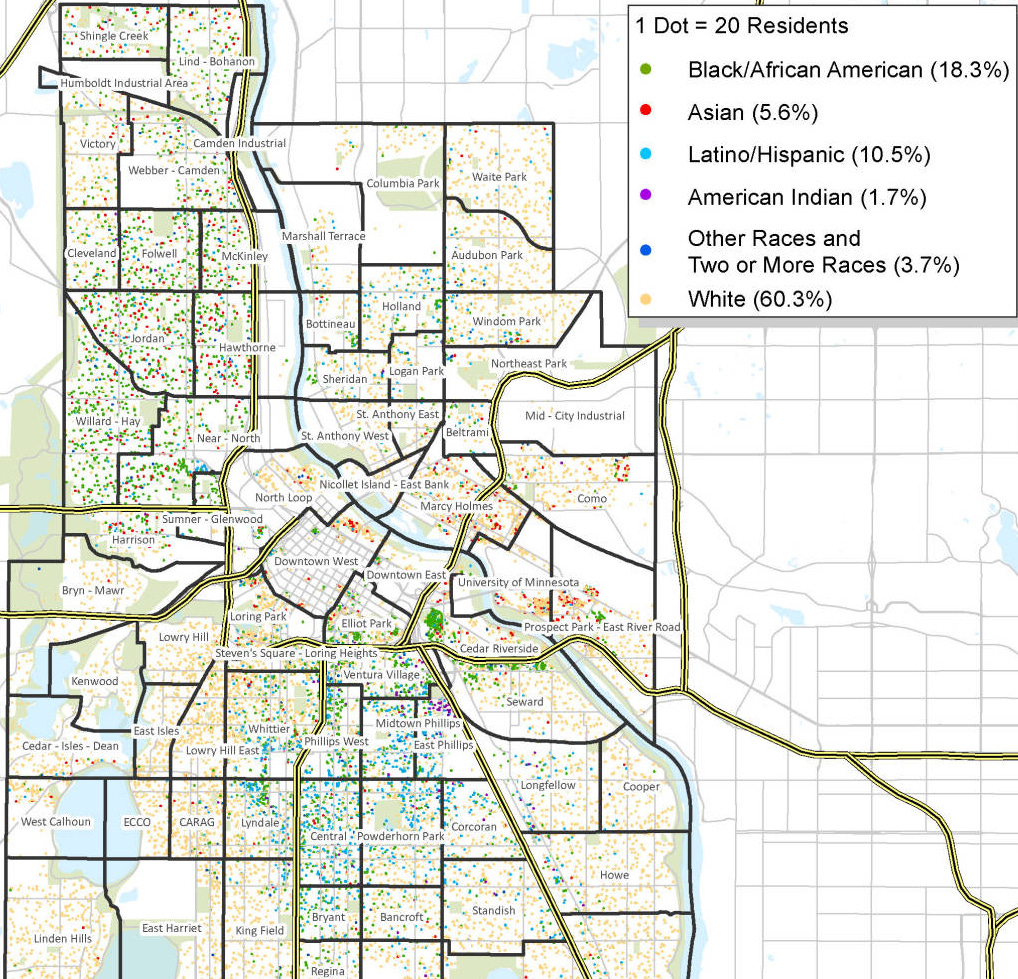
Black Minneapolitans largely live in three areas. North Minneapolis (confusingly actually to the northwest), Phillips in south central Minneapolis, where George Floyd was killed, and Cedar Riverside just to the east of the city centre, where the Somali community is centred. Hispanics tend to also live in the Phillips neighborhood as well as to its south and west. Asians and American Indians (Native Americans) are more spread out for the most part, though there is a big American Indian community in East Phillips.
George Floyd’s killing set off weeks of protests in Minneapolis, largely in the Phillips area and in Uptown to its west. I think it’s fair to say that these protests in some cases got out of hand - there were genuine riots and the burning of police stations. It was apparently the second most costly set of riots after the LA riots of the 1990s. And although the violent turn was unusual in Minnesota, what was less unusual was that protest groups continued to actively organise over the next few years in an attempt to reform local policing. There is a very long Wikipedia page all about this should you wish to go down a rabbit hole.
There are three important things to take from the George Floyd era in Minneapolis. First that, as I noted above, both the violent and non-violent protests were ethnically mixed. Second, that civic leaders did indeed reform the local police, improving relations with community organisers over time. And third, that there was a general sense that violent protest was an unfortunate aberration and was unlikely to be as successful in creating change than non-violent activism.
SIDE NOTE: there was semi-famously a grand debate in 2020 about the merits of violent versus non-violent protest over an article (open access) written by the political scientist Omar Wasow that noted the latter had been more successful in the 1960s. When the pollster David Shor recommended this piece, he found himself turfed out of his liberal-leaning organisation. A different world…
Let’s move on to this month’s events. In early January 2026, Donald Trump’s administration decided it would send ICE and CBP into Minneapolis in a show of strength. The immediate reason behind this was a viral right-wing video made by Nick Shirley, accusing various Somali daycares of massive fraud. This built on actually documented COVID-scheme fraud in Minnesota that has caused big political problems for Governor Tim Walz, and may in part explain why he isn’t re-running for office. This MPR report provides a useful account.
The always too-online White House seized on these allegations as an excuse to send in immigration enforcement to Minneapolis. Some of this was indeed targeted at Somali communities in Cedar-Riverside. However to ICE’s possible frustration, most Somali ethnicity residents are either American citizens or long-standing immigrants with green cards or legal visas.
Which is one reason I suspect that ICE decided since it was in Minneapolis it would look elsewhere. And the obvious place to look for people with less robust immigration status would be among Latino communities, since those make up a large proportion of undocumented residents of the USA.
That’s why it has once again been Phillips - the site of George Floyd’s murder - and Uptown, just blocks from my old house, that have seen the frankly insane images of troops of ICE and CBP ‘patrolmen’ and armoured vehicles like something out of Fallujah. And it has also been where Renee Good and then Alex Pretti were murdered.
The stretch from Uptown east to Powderhorn Park is Minneapolis’ most diverse and it is also one with both large white communities and ethnic minority communities. This is an area where cross-ethnic group ties and organisation have been longstanding, particularly after the killing of George Floyd. And it is unsurprisingly an extremely liberal area (Uptown being full of hipster yuppies and Powderhorn being full of hippies).
You can see from the map above that Minneapolis is divided into neighbourhoods. These are not mere geographical conveniences - Minnesotans love community organisation. And that meant when ICE came to town, local block groups immediately came together with whistles and phone trees to warn neighbours about their arrival. People would go out on the street filming ICE and chanting against them. And they would follow them around in cars. Minnesotans were largely very careful to keep these activities on the right side of the law.
Remember the lesson Minnesotans learned from 2020 - non-violent responses would likely be more effective. Remember also that relations with the city - including its police department - and the state had improved. So local forces had no interest in helping out ICE at all, to ICE’s great anger and chagrin.
Indeed, ICE’s anger has quickly spilled over into massive and fatal over-reaction. Infuriated by mass peaceful opposition by the community and the lack of collaboration with the feds by local police, ICE became more and more aggressive. There are countless videos out there, beyond the era-defining ones of the killings of Renee Good and Alex Pretti, that demonstrate ICE agents’ complete lack of self-control and restraint.
Some people have argued that ICE agents are dumbstruck and hostile because they cannot understand why white Minneapolitans are protecting their ethnic minority neighbours. I’m slightly more skeptical about that since many ICE agents are themselves ethnic minorities. I’m less skeptical about the idea that the agents find female protestors like Renee Good particularly hard to accept. I’m absolutely willing to believe that legions of far-right chuds on X are in a state of shock about ‘race traitors’ in Minneapolis and the ability of women to organise and sustain a weeks-long resistance. And who knows, perhaps some of those attitudes are also held by certain denizens of the White House.
But the crucial mistake that ICE/CBP made was to imagine that Minneapolis, of all places in the world, would be easily cowed. Anyone who has read Bob Putnam’s seminal Bowling Alone, will remember that Minnesota is always at the top (sometimes with Utah) of every measure of social capital in America. Minnesotans trust each other. Regardless, for the most part, of ethnicity. And they know how to caucus.
Plus it’s also minus twenty degrees centigrade. ICE’s invasion of Minneapolis was like Napoleon’s invasion of Russia, if nineteenth century Russians had also been world-leaders at organising cook-outs, help-meets, and charity drives.
What it means to be a success in Minnesota seems very at odds with the MAGA view of the world. It is an other-focused place, well-ordered, obsessed with good government and welcoming refugees.
Look at Alex Pretti - an outdoorsy, gun-carrying, graduate (of my old university UMN), ICU nurse, who was injured by ICE agents when warning people of their arrival and then a few days later showed up again, helped women off the icy ground after they had been kicked by out-of-control ICE agents, and then was shot several times point blank for his courage. His last words were “Are you OK?”
Or look at Renee Good - a poet, a mother who sent her kid to a small social justice focused school, who served as a Christian missionary in Northern Ireland, who showed up early after ICE’s arrival in her car to monitor agents and was shot for having the temerity to move her car slightly too quickly. Her last words were “I’m not mad at you” before she was killed and pronounced “a fucking bitch”.
Alex Pretti and Renee Good were real people of character. Real Minneapolitans who did their city proud.
Minneapolis cherishes this type of person. It has none of the carnival barker, incel chaos of the MAGA right. It cannot be cowed by blood-curdling Steven Miller speeches or trash-talking ICE agents. It views them with the same weary disdain as a parent might when their errant teen first starts swearing at them.
And it looks increasingly like the teen is being sent to their bedroom. Greg Bovino - the CBP chief - has been removed from Minneapolis. The raids still continue there but something in the American weather has changed. Normies, many of them supportive of deporting illegal immigrants, have started to shift uneasily about what that process has actually turned into. The misrepresentations and plain lies that administration officials have fallen back onto now look like the hollow bullshit of desperate fools rather than the untouchable fictions of autocrats creating their own truth.
If there is a moment when in retrospect we can say the veil fell from the American public’s eyes about the true nature of Trump’s second term, I think we will find it in the frozen streets of Minneapolis in January 2026. The American people, the people of the world, will have the courage and decency of the residents of Minneapolis to thank. That’s my Minneapolis.
I will second what Sprint said: that was beautiful, Ben. Thank you for the post.
Thanks Ben. That was beautiful.
I spent the happiest years of my life in Pollokshields on the south side of Glasgow. I recognise so much of your Minneapolis in that community where they surrounded an immigration van for many hours until their eventual retreat and we organised a festival of resistance the following year.
I fear Pollokshields has put a target on their back, and will be one of the top targets for a Reform ICE to make an example of, and this terrifies me.
I'm desperate for progressives to explore all avenues to stop this happening, and think I may have made a breakthrough modelling an AV election result using BES favourability data